DeepRoute.ai Presents 40B Vision-Language-Action Foundation Model at NVIDIA GTC 2026, Accelerating Autonomous Driving at Scale
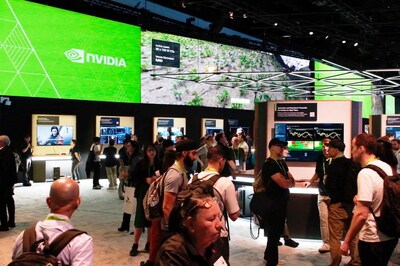
SAN JOSE, Calif., March 17, 2026 /PRNewswire/ -- At NVIDIA GTC 2026, DeepRoute.ai presented a comprehensive introduction to its 40-billion-parameter Vision-Language-Action (VLA) Foundation Model architecture, representing a fundamental breakthrough in autonomous driving development. The model introduces a unified architecture that integrates perception, reasoning, and action, enabling systems not only to drive, but to understand and evaluate their own decision-making in real time.
DeepRoute.ai has already achieved significant commercial success, having delivered its advanced autonomous driving systems across more than 250,000 production vehicles. In October 2025, DeepRoute.ai captured nearly 40% market share among third-party suppliers in the high-level autonomous driving segment for a single month. Building on this momentum and fueled by the continuous evolution of its Foundation Model, the company is targeting deployment of one million vehicles equipped with its advanced driving solutions by the end of 2026.
Breaking the Bottleneck: From Days to Hours
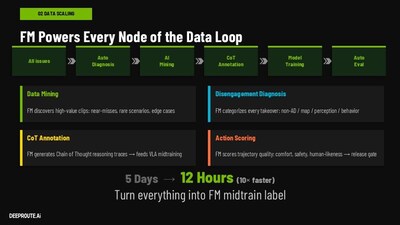
Autonomous driving development has long been hampered by the inefficiencies of traditional "data closed-loop" workflows. In conventional systems, data must be manually collected, reviewed, annotated, and retrained—a process that typically requires more than five days per iteration. Meanwhile, companies accumulate vast volumes of raw driving data, most consisting of routine scenarios that offer limited training value and can even degrade model performance.
"At its core, autonomous driving is a scaling problem," said Tongyi Cao, CTO of DeepRoute.ai. "While the industry has made significant progress, true large-scale deployment remains elusive because traditional execution paths are flawed. The bottleneck is no longer about acquiring data; it is about how efficiently a system can filter out the noise and convert massive amounts of raw data into high-value training samples."
DeepRoute.ai's solution: compress the data processing cycle from over five days to approximately 12 hours through intelligent automation.
One Model, Three Roles: Driver, Analyst, and Critic
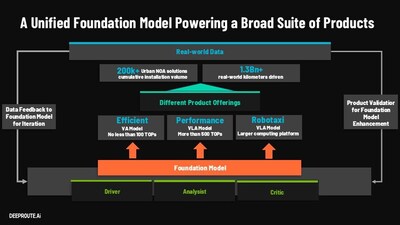
The 40B VLA Foundation Model performs three complementary functions simultaneously:
The Driver – Executes real-time driving actions based on visual inputs
The Analyst – Identifies critical driving events and explains decisions through causal reasoning
The Critic – Evaluates trajectories for safety, comfort, and human-like behavior
"Our solution to the industry's scaling bottleneck is a unified, 40-billion parameter Vision-Language-Action Foundation Model," Cao explained. "This model goes beyond basic vehicle control. It possesses the capability to analyze data and evaluate driving behavior. Simply put, this model serves not only as the 'driver,' but simultaneously as the 'analyst' and the 'critic.'"
By embedding these capabilities within a single foundation model, DeepRoute.ai has automated large portions of the data pipeline. The system autonomously identifies high-value events such as near-misses and rare scenarios, performs root-cause analysis, and generates reasoning annotations, all without manual intervention.
A Self-Evolving Data Flywheel
The architecture enables a self-reinforcing development cycle where improvements in driving performance directly enhance the system's ability to process and curate its own training data.
"Traditional data closed loops are highly dependent on manual human processes, which severely limits iteration speed," said Cao. "By leveraging our Foundation Model, we have entirely reconstructed this workflow. The model autonomously handles data mining, reason diagnosis, and behavior scoring. Every single iteration of this workflow compounds directly into a measurable enhancement of our AI capabilities."
This self-evolving flywheel accelerates capability growth while dramatically reducing reliance on manual labeling.
Scale and Momentum: 250K to 1M Vehicles
"By the end of 2025, we successfully delivered over 250,000 mass-produced vehicles equipped with DeepRoute.ai's autonomous driving systems," Cao said. "The Foundation Model serves as the core cornerstone for DeepRoute.ai's next-generation autonomous driving assistance and functions as a fundamental AI framework for the physical world. This unified architecture enables the system to go beyond mere execution; it understands complex traffic environments, explains the underlying logic of its decisions, and evaluates driving behaviors. This evolution provides its autonomous driving systems with more comprehensive cognitive and decision-making capabilities."
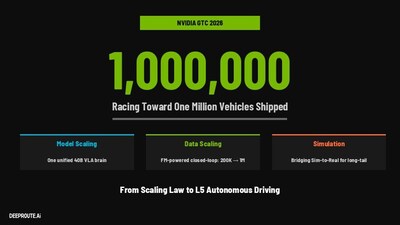
Through its presentation at GTC 2026, DeepRoute.ai demonstrated how its 40B Vision-Language-Action Foundation Model architecture is accelerating the path to scalable, safe autonomous driving through continuous, data-driven learning and rapid iteration cycles.
About DeepRoute.ai
DeepRoute.ai is a leading artificial intelligence company developing advanced autonomous driving systems. Driven by the vision of achieving Artificial General Intelligence (AGI) for the physical world, the company leverages state-of-the-art foundation models to deliver highly reliable, safety-first autonomous driving solutions. Backed by top-tier investors with over $700 million in funding, DeepRoute.ai has successfully deployed its systems across more than 200,000 mass-produced consumer vehicles. By prioritizing scalable and innovative smart mobility, the company is establishing a robust foundation to pioneer the future of commercial Robotaxi operations.

Photo - https://mma.prnewswire.com/media/2935825/image1.jpg
Photo - https://mma.prnewswire.com/media/2935826/image2.jpg
Photo - https://mma.prnewswire.com/media/2935824/image3.jpg
Photo - https://mma.prnewswire.com/media/2935827/image4.jpg
Logo - https://mma.prnewswire.com/media/2643560/DeepRoute_ai_Logo.jpg
 View original content:https://www.prnewswire.co.uk/news-releases/deeprouteai-presents-40b-vision-language-action-foundation-model-at-nvidia-gtc-2026-accelerating-autonomous-driving-at-scale-302716118.html