From episodic trade shows to continuous market connectivity: Crab2B to convene Hong Kong mobile B2B exchange and release its first market intelligence report in November
Following an unexpected change to plans for its industry presence at GSMX Hong Kong 2026, Crab2B is sharpening its focus on live WTB/WTS, real available inventory and upstream market signals across the secondary mobile-device and recommerce sectors.
HONG KONG, Aug. 26, 2026 /PRNewswire/ -- Crab2B, a Hong Kong-based B2B platform for the mobile-device and consumer-electronics trade, will convene a Hong Kong mobile B2B industry exchange this November and publish its first market-intelligence report, following a change to plans for Crab2B's industry presence at GSMX Hong Kong 2026 through a partner company.
The development highlights a structural issue Crab2B is seeking to address: trade shows create valuable periods of high-density business interaction, while the mobile B2B market operates continuously. Sourcing requirements emerge daily, inventory moves constantly and wholesale pricing can change well before the next industry event.
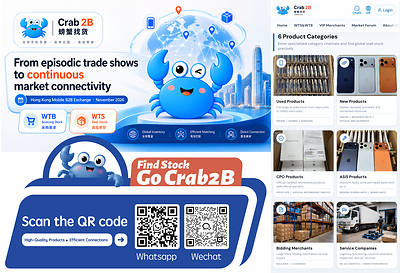
Through WTB (Want to Buy) and WTS (Want to Sell), Crab2B continuously connects active sourcing requirements with real available inventory. The platform currently brings together approximately 200 industry merchants, while its internal merchant mapping identifies more than 300 mobile-device and consumer-electronics businesses within the trading cluster around 1 Hung To Road, Kwun Tong, Hong Kong.
This proximity to Hong Kong's upstream trading market provides visibility into signals increasingly relevant to international buyers, including real available inventory, strengthening buying demand, wholesale price movements and changing supply-demand sentiment.
These transaction-side signals will form the basis of Crab2B Mobile Trade Signals 2026. The report will draw on anonymised WTB/WTS activity, merchant inventory signals, pricing observations and industry feedback to assess trends relevant to Hong Kong SAR, Europe, Japan and other major secondary-device markets.
For distributors, wholesalers and recommerce businesses across Europe and other international markets, these signals can provide earlier visibility into upstream supply conditions, helping businesses identify shifts in inventory, sourcing demand and wholesale sentiment before they are fully reflected downstream.
"Trade shows remain essential for building trust, but WTB, WTS, inventory and pricing move every day. Crab2B aims to turn those daily trading signals into information the market can use continuously," said Luo YaoHong, Founder of Crab2B.
The November exchange will extend this model offline through live WTB/WTS, real available inventory, buyer-supplier matching and market discussion.
The exchange is expected to take place at Shop 3, G/F, 1 Hung To Road, Kwun Tong, Kowloon, Hong Kong SAR.
Crab2B sees digital platforms and traditional trade shows as complementary:
Trade shows concentrate the industry. Digital platforms keep the market connected.
About Crab2B
Crab2B is a Hong Kong-based B2B trading and market-intelligence platform for the mobile-device and consumer-electronics industry, connecting buyers, suppliers, wholesalers and recommerce businesses through live WTB/WTS, real available inventory and transaction-side market signals, with the long-term goal of building a global trading network.
 View original content to download multimedia:https://www.prnewswire.co.uk/news-releases/from-episodic-trade-shows-to-continuous-market-connectivity-crab2b-to-convene-hong-kong-mobile-b2b-exchange-and-release-its-first-market-intelligence-report-in-november-302860656.html