TCL CSOT Highlights APEX-Powered Display Innovations for Next-Gen Applications at SID Display Week 2026
Guided by its APEX philosophy, TCL CSOT extends its vision through APEX Pixel, delivering immersive, efficient, and eye‑friendly display experiences across home entertainment, mobile communication, smart mobility, and personal immersion.
LOS ANGELES, May 6, 2026 /PRNewswire/ -- TCL CSOT, a global leader in advanced display technologies and a subsidiary of TCL Technology, today presented its forward‑looking vision for the display industry at SID Display Week 2026. Anchored in its APEX philosophy, this vision is expressed through the APEX Pixel framework, which delivers pixel‑level breakthroughs across FMM OLED, IJP OLED, LCD, and other advanced display technologies. At the event, TCL CSOT showcases how these innovations are shaping the next generation of experiences in home entertainment, smart mobility, mobile communication, and immersive experience.
"APEX is more than a benchmark in display technology. It is a bridge connecting us with consumers worldwide," said Jun Zhao, SVP of TCL Technology and CEO of TCL CSOT. "Through APEX-led, full-stack innovation, TCL CSOT is making 'Display the Future' accessible in the era of Al across every aspect of everyday life. This year, our IJP OLED solutions will also debut in the mid-size segment."
The APEX Philosophy: A Human‑Centric Vision for Displays
APEX is TCL CSOT's systematic answer to what defines a truly great display. It is built on four pillars that guide research and development to ensure every innovation delivers meaningful, human-centric benefits:
- Amazing Display Experience – Elevating immersion, fluidity, and vivid color performance across scenarios, from mobile screens to the large-format displays.
- Protective of Eye Health – Integrating natural light technologies and visual science to balance stunning picture quality with long‑term visual comfort.
- Eco‑Friendly to Build and Use – Embedding eco‑friendly principles into development, with low‑power OLED and energy‑efficient LCD solutions that reduce consumption while maintaining premium performance.
- X‑Unlimited Imaginative Potential – Exploring future possibilities with AI-driven holographic displays, Micro LED, and XR applications that expand the boundaries of interaction and creativity.
Bringing the APEX Vision to Life Across Everyday Scenarios
At SID Display Week 2026, TCL CSOT demonstrated how its APEX philosophy — embodied in the APEX Pixel framework — is applied to enhance key aspects of modern life.
Home Entertainment Scenario
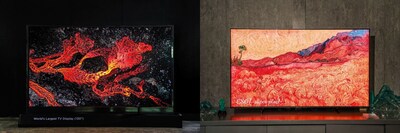
Bringing the "Amazing Display Experience" pillar to the living room, the World's Largest HVA Ultra TV Display (130") breaks traditional LCD size boundaries and redefines large-format design with an ultra-slim 29.8 mm profile. Meanwhile, the World's Highest Image Quality WHVA Ultra LCD TV Display (85") uses a native RGBC four-color pixel arrangement. This APEX-driven innovation delivers color reproduction that is more lifelike and natural, creating a deeply immersive home cinema experience for the whole family.
Smart Mobility Scenario
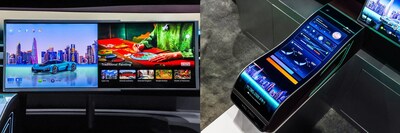
The APEX vision for a seamless, integrated user experience extends into the vehicle with the Intelligent Cockpit Display Suite 3.0. Its centerpieces — the World's First IJP OLED Sliding Central Control Display (28"), a dynamic sliding control screen, and the World's First IJP OLED Curved Armrest Display (28"), a sculpted curved armrest screen — showcase how the flexibility of IJP OLED technology can create a more intuitive, integrated, and seamless "third living space."
Daily and Business Scenario
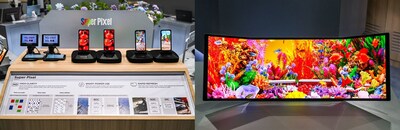
To meet the evolving demands of modern mobile communication, TCL CSOT's APEX-driven solutions prioritize performance and flexibility, with Super Pixel technology delivering mobile displays with Higher Clarity, Smarter Power Use, and Rapid Refresh.
For hybrid work, the World's First Foldable & Portable IJP OLED Monitor Display (28") brings IJP OLED technology into a highly versatile design, transforming from a compact device into an expansive ultra-wide screen that empowers productivity anywhere.
Immersive Entertainment Scenario
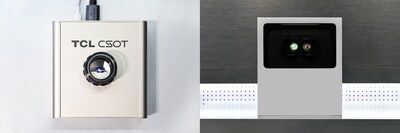
Pushing the boundaries of imagination, TCL CSOT's "X-Unlimited Imaginative Potential" vision for XR is realized in forward-looking concepts. Innovations like the World's Highest PPI Single-Chip Full-Color Si-Micro LED Display (0.28") and the World's Highest 1700PPI Real RGB G-OLED Display (2.24") offer a glimpse into a future of deeply personal and interactive entertainment, made possible by the pioneering spirit of APEX.
- End -
About TCL CSOT
Established in 2009, TCL China Star Optoelectronics Technology Co., Ltd. (TCL CSOT) is a leading global innovator in display technologies. Its LCD, OLED, and MLED solutions power applications across TVs, smartphones, tablets, laptops, monitors, automotive systems, VR/XR, and commercial displays. With a clear strategic direction set by its advanced display technology brand APEX, TCL CSOT invests continuously and strategically in R&D, driven by a mission to amaze, protect and inspire all people through endlessly innovative display technology. As part of TCL's Worldwide Olympic Partnership, TCL CSOT is proud to deliver display solutions that elevate experiences on the global stage.
Photo - https://mma.prnewswire.com/media/2973718/WhatsApp_Image_2026_05_06_at_3_52_54_PM.jpg
Photo - https://mma.prnewswire.com/media/2973716/WhatsApp_Image_2026_05_06_at_3_52_53_PM__1.jpg
Photo - https://mma.prnewswire.com/media/2973719/WhatsApp_Image_2026_05_06_at_3_52_53_PM.jpg
Photo - https://mma.prnewswire.com/media/2973717/WhatsApp_Image_2026_05_06_at_3_52_52_PM.jpg
 View original content:https://www.prnewswire.co.uk/news-releases/tcl-csot-highlights-apex-powered-display-innovations-for-next-gen-applications-at-sid-display-week-2026-302764161.html