Two‑day Global Prosperity Summit 2026 concludes successfully
Second-day highlights: digital finance, international trade, aerospace development
HONG KONG, May 20, 2026 /PRNewswire/ -- The two‑day Global Prosperity Summit 2026 (GPS 2026) successfully concluded today following three fruitful panel discussions. The second day's agenda focused on digital finance, international trade and aerospace development, bringing together global leaders and experts to exchange insights on issues critical to Hong Kong's future and global prosperity. The successful staging of GPS 2026 further underscores Hong Kong's role as a leading platform for cross-disciplinary exchange, showcasing the city's soft power in Track II Diplomacy and its extensive network of international expertise.
GPS 2026 was jointly organised by the Savantas Policy Institute, the Shanghai Institutes for International Studies ("SIIS") and the European Chamber of Commerce in Hong Kong. Mrs Regina Ip, Chairperson of the Board of Governors of the Savantas Policy Institute, said, "We are very grateful to Ambassador Han Zhiqiang for attending in person and for explaining China's Global Governance Initiative. In addition, the summit's discussions focused on several important topics, including Hong Kong's positioning as a hub for innovative drug development and as a center for culture, sports, and entertainment. The summit also discussed international trade and the future development of digital finance and explored whether Hong Kong can play an important role in the space economy. The speakers at the summit were of a very high calibre, and the in-depth discussions provided Hong Kong with valuable insights into how it should position itself in the future."
She added: "One of my takeaways from the summit is that the urgency of Hong Kong to establish a 'Space Office,' so that Hong Kong can play a key role in the space economy. This is something Hong Kong can do, because we have strong foundations and a well-established services system to support the development of the new aerospace economy. Hong Kong can provide services in multiple fronts, including financial services, legal services, arbitration services, and conduct analysis on satellite data for emerging aerospace companies."
The summit hosted a panel on the evolving landscape in digital finance, where speakers shared perspectives on market developments, regulatory considerations, and emerging trends shaping the sector.
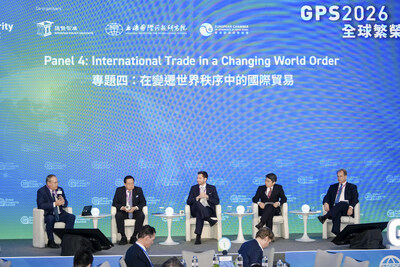
The panel discussion on "International Trade in a Changing World Order" was timely and a highlight of the summit, underscoring the topic's relevance to current global economic and geopolitical developments. Experts from Asia, Europe and the US offered valuable insights on this pressing issue. Datuk Professor Dr Mohd Faiz Abdullah, Executive Chairman of the Institute of Strategic & International Studies ("ISIS"), Malaysia, said, "Speaking on behalf of how we look at trade from think tanks and Track II Diplomacy, Hong Kong will have to be one of the major drivers in promoting regional growth."
Mr Mark Boris Andrijanič, Member of the Board of the European Institute of Innovation and Technology ("EIT"), said, "There's an opportunity for a broader partnership between the EU and China across a variety of issues – be it climate change, where we think pretty much along the same lines, or in the area of U.N. reform, because both the EU and China are very committed to the U.N. and other international organizations. And obviously, trade should be on the top of all issues."
Professor Kaisheng Li, Vice-President of the SIIS, said, "Hong Kong knows the West very well, and, of course, the Mainland. It is indeed a bridge to minimize cultural gaps between China and the rest of the world."
Another focal point was the development of the space economy, explored through two dedicated sessions: "Fireside Chat: Progress on The New Space Economy since GPS2025" and the panel on "Hong Kong as a Facilitator of Aerospace Development", where speakers discussed the role that Hong Kong could play and the expertise, particularly in financial, legal and logistical services, that it could contribute to the emerging space economy.
Summit organisers expressed gratitude to all their distinguished guests, noting the valuable participation of experts and scholars from the Chinese Mainland and across the world whose contributions fostered in‑depth exchanges of ideas and inspired forward‑looking perspectives. Looking ahead, they added that the Global Prosperity Summit will continue to reinforce Hong Kong's position as a leading global hub for cross-disciplinary exchange while fostering collaboration, driving innovation and advancing sustainable prosperity worldwide.

About Global Prosperity Summit
The Global Prosperity Summit was initiated by a group of business leaders, academics and experts in Hong Kong to provide a platform for frank, objective and rational discussion of key issues shaping global prosperity. The inaugural Summit was held in Hong Kong in 2024.
About Savantas Policy Institute
The Savantas Policy Institute (SPI) was established in 2006 by a group of Hong Kong residents with international experience who are committed to the city's future development. SPI's mission is to support Hong Kong's transition into a knowledge-based economy through public policy research, strategic recommendations, and the promotion of public understanding and participation in economic and social development.
About Shanghai Institutes for International Studies
Established in 1960, the Shanghai Institutes for International Studies (SIIS) is a leading think tank dedicated to research on international politics, economics and security. It plays an important role in providing policy recommendations and advancing understanding of global affairs and is widely recognised as one of China's most influential research institutions.
About European Chamber of Commerce in Hong Kong
Established in 1997, the European Chamber of Commerce in Hong Kong (EuroCham) is a non-governmental business interest group comprising 16 European chambers based in Hong Kong. Representing over 1,600 European companies operating in the city, EuroCham promotes European business interests and strengthens economic ties between Europe and Hong Kong. Europe is Hong Kong's second-largest trading partner after the Chinese Mainland.
Logo - https://mma.prnewswire.com/media/2984376/Logo_final_Logo.jpg
 View original content:https://www.prnewswire.co.uk/news-releases/twoday-global-prosperity-summit-2026-concludes-successfully-302777822.html